Posts

Principles: Leading Yourself First

Image
What are your principles? Have you given them much thought? In many organizations, especially law enforcement agencies, we don’t do a stellar job of training our first-line supervisors in leadership OR management. It is not fair to those who have been selected, but it is also not fair to the employees. You don’t want to get six months (or more) into a supervisory position only to discover that supervision is not something you want to do. Training supervisors in many agencies is a little like being put into a dark room, not being familiar with where things were, and trying our best to turn on the light. Many new supervisors are faced with those challenges—some have even been told, “you’ll learn it on the job.” But what if we were able to utilize a principles-based leadership training system to help smooth that transition? Leading through principles – and having the training, development, and organizational succession planning structure to support this effort -- is essential to givin...

Developmental Goals and Experiences for Mentoring

Image
I have written extensively on the value of mentoring, both as a mentor and a mentee ( here and here for Fraud Magazine and here for the ACFE Blog ). Throughout my career, my journey has been positively influenced by so many wonderful people—both through formal mentoring programs and informal mentors. One question I often get is about how a mentee can gain experience to be able to obtain the requisite knowledge and work history to gain a position in the fraud, investigation, or law enforcement profession. Some are from students who are looking for their first career position after college, while others are transitioning from one industry to another, or rejoining the workforce after having a family or helping older parents. Those who are in the field may be interested in moving into supervisory or leadership positions, which also come with different experiential requirements. This is where a mentoring relationship can be extraordinarily valuable; the mentor can be a sounding board...

Law Enforcement Social Media: A Leadership Imperative

Image
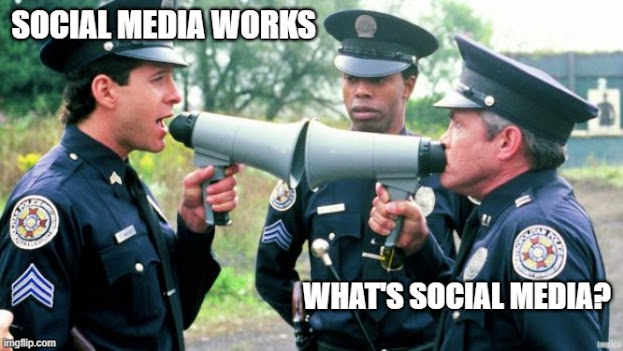
  Many police agencies are on social media -- but are they being utilized effectively as a strategic communications platform? And are agency leaders aware of how important they are, and what opportunities (and risks) they present? An astounding number of people are now on social media platforms; the We Are Social 2022 report for the United States indicates that users on average spend just over seven hours a day on the internet or social media. It may sound like a lot, but compared to some other countries (South Africa clocks in at 10 hours, 46 minutes and Mexico at eight hours, 55 minutes), apparently we do other stuff. Leaders can use these statistics to help understand the social media environment and how they can chart a social media strategy for their agency. Law enforcement can use social media to support many of their activities and operations. Not fully understanding social media, the platforms, and expectations of the public can pose risks to law enforcement agencies a...

Red flag Friday - The Maintenance Guy

  It’s #redflag Friday. Each Friday, I will share a specific indicator to be on the lookout for fraud, waste, corruption, or other misconduct.   🚩🚩🚩🚩🚩🚩🚩🚩🚩🚩🚩🚩 Purchase cards are helpful to expedite and obtain needed supplies, repair services, and smaller items that may not need to go through a longer, formal procurement process. But they can be misused just as any credit or debit card. One recent case involved a Director of Maintenance who approached vendors to provide him with regular cash payments of approximately $1,000 to $2,000 per month; in exchange for those payments, the vendors falsely billed his employer using their purchase card system for items that the vendor sold but ultimately never provided (or never intended to provide). Because the false purchase charges covered the cash payments, they also provided a substantial amount of fraudulent income to the vendor. What purchase card controls are in place? Who actually has them (and do they REALLY need them)...

Leadership Lessons and Strategic Communication

Image
Back in 2021,  I took a graduate course on communication and relationship building as part of my graduate certificate in leadership at the University of Southern Maine . As I began the class, I believed I had a good handle on communication. In college, I worked with multiple national media outlets and reporters who covered our NCAA sports teams . In my professional career, volunteer service, and speaking and writing, I try to think a lot about how to best get my point across. But I was wrong . In reality, I had barely scratched the surface. The communication course crystalized some major concepts that I thought I knew well and enabled me to take things to an entirely new level. Three major “take-aways” for me from that course were: 1) the importance of being strategic in all our communications; 2) the tools and techniques leaders use to effectively communicate the destination; and 3) the imperative of brevity in our world of endless scrolling and distractions. Thinking Big Picture ...

Red flag Friday - IT access

It’s #redflag Friday. Each Friday, I will share a specific indicator to be on the lookout for fraud, waste, corruption, or other misconduct.   🚩🚩🚩🚩🚩🚩🚩🚩🚩🚩🚩🚩 Part three of information technology and #fraud.  IT professionals have unprecedented access to information, which they can misuse. For a two year period, one IT manager used his position and access to obtain confidential information and exploited market-moving stock recommendations prior to their release to paying subscribers.  The IT manager then traded on them before they became public and was able to obtain significant profits unavailable to other market participants.  These total gains included at least $3.5 million. What information is so sensitive that its access should be tracked and logged? Have you audited your system logs lately? What unusual or odd patterns can emerge? And who is the independent party who can help determine if there is (or could be) a problem? #compliance    ...

After-Action Reviews: A Guide for Reflection

Image
Is your agency conducting After-Action Reviews (AARs) on a routine basis? Are you collecting the best practices, lessons learned, and retaining and sharing them for others?  If not, your agency may be missing a huge opportunity in knowledge collection and retention. AARs can also be an important part of your leadership, including command staff doing it together.  AARs, based on the military's post-battle or training group debriefs , are structured post-event critiques or reflections that enable participants to debrief on what occurred and what went well—and what did not go well. These are non-judgmental, but rather are fact-based observations to better enable and execute future operations.  The U.S. Forest Service (USFS) has published a two-page AAR guide that is used to train and debrief fire crews. The resource has three primary elements: (1) AAR purpose; (2) process overview; and (3) facilitator considerations. The guide defines AAR as a post-event process to identify...